
Choosing, Growing and Caring for Ground Cover Thymes
Ground Cover Thymes are not only beautiful and soft to walk on, they are also the perfect way to keep the ground cool and conserve moisture. Once established, ground cover thymes also help to keep weed seeds from sprouting.
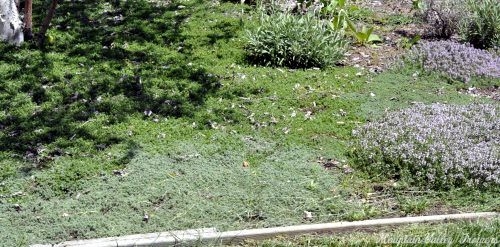
Pink Lemonade Thyme is the bright green thyme that has the shadow of the tree on it. It flows into the silvery, non-flowering Woolly Thyme near the boundary board which separates this garden from the lawn. The taller flowering Caraway Thyme is in the foreground to the right of the Woolly Thyme. In the back, Pink Heretus Thyme is also in full bloom. If you look closely you can see a small patch of a slightly bluer thyme in between the two flowering ones. This is the tiny Elfin Thyme. It is being threatened by the fast growing Pink Lemonade Thyme which will probably take over both the Elfin Thyme and the Woolly Thyme in a year or so.
CHOOSING THE RIGHT GROUND COVER THYME
Thymes are a blessing and a curse. A blessing because there are so many different kinds and a curse because there are so many different kinds. Culinary Thymes are pretty easy. There aren’t too many and their names are fairly descriptive, like Lemon Thyme and Orange Balsam Thyme.
It is the Ground Cover Thymes that tend to confuse. Most folks want to use the Ground Cover Thymes to cover the ground. Not much of a surprise there. But, different folks have different amounts of ground to cover and different expectations of what a ground cover is. It is important to know the difference between a ground cover thyme that is appropriate for a two-inch space and one that is appropriate for a twenty foot space. It is also necessary to understand that all ground covers are not flat and lawn like.
Faster growing thymes stuffed into a small space will disappoint with time. They will cover up stepping stones, spreading their stems onto paving searching for ground in which to root. Slower growing thymes are more appropriate for small spaces like those between flagstones.
How They Grow
Just like all plants, thyme plants spread by growing from one set of leaves to the next. In between the leaves is a stem segment. Some thymes produce sets of leaves very close together while others are spaced further apart. Stem segments grow faster without having to produce tightly knit sets of leaves.
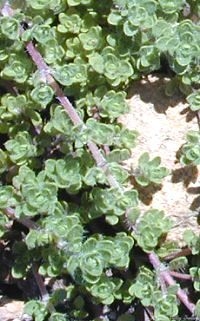
The increased stem segment also provides a greater rooting zone for the thyme allowing it to spread faster. As long as the ground is moist where that stem segment hits, the plant will root and continue to creep.
Ground Cover Thymes can take light foot traffic. However, just like any plant, if the leaves are repeatedly rubbed they will fall off and the plant will die. If you have a high traffic area, consider putting in a hardscape walkway with thymes in between.
The Big and the Small of It
Slower growing thymes for in between stepping stones and flagstones include:
- Annie Hall
- Elfin Thyme
- Leprechaun Thyme
- Silver Needle Thyme
- Pink Chintz Thyme
- Mint Thyme
- Woolly Thyme
- White Moss Thyme
- Highland Cream Thyme
Elfin Thyme and Leprechaun Thyme are very small and very flat (about 1/4 inch to 1/2 inch tall). They are the slowest growing of this group and are the logical choices for those two inch wide spots. They bloom very little which helps them to remain closer to the ground.
Pink Chintz Thyme, Mint Thyme and Annie Hall are slightly taller (1 to 2 inches with the flowers) but have the distinction of putting on a spectacular flowering show. Pink Chintz blooms very early in spring, followed by Mint Thyme, with Annie Hall blooming well into the summer.
Woolly Thyme and White Moss Thyme (sometimes called Creeping White Thyme) are also slower growing, very flat and do well between stones where space is cramped. Woolly Thyme is the most silver leaved of all the Thymes and never blooms, while White Moss Thyme is a lovely chartreuse with little white flowers in late spring.
Highland Cream Thyme is our variegated stepping stone filler. Leaves of soft cream and green make this tiny thyme a must have for brightening up dark stones. In hot summer areas, it prefers afternoon shade.
Silver Needle Thyme has the most unique leaf structure and grows flat enough to make a good flagstone filler.
Faster growing, wider spreading thymes more suitable for large spaces include:
- Pink Lemonade Thyme
- Doone Valley Thyme
- Goldstream Thyme
- Creeping Pink Thyme
- Caraway Thyme
- Lavender Thyme
- Lemon Frost Thyme
- Loveyanus Thyme
- Reiter’s Thyme
- Hall’s Woolly Thyme
- Coconut Thyme
Of these large space thymes those that are lowest and most suitable for areas that you want to look more like a lawn are Pink Lemonade, Goldstream, Creeping Pink, Lemon Frost, Reiter’s, Hall’s Woolly and Coconut.
Caraway Thyme is the fastest growing and has a pillowy mounding habit instead of a “looks like a lawn” habit. It can be walked on and is extremely rugged. It cascades nicely down hillsides that aren’t too steep. Caraway Thyme is the only culinary Ground Cover Thyme in the bunch.
Lavender Thyme will spread like a ground cover but it does get taller and is more suitable for areas that need cover but don’t get walked on too much.
Doone Valley Thyme is one of our favorite ground cover thymes but again it is a bit taller at about four inches with flowers.
Loveyanus Thyme is amazingly beautiful in large spaces. It has the largest flower of all the thymes and works well planted with other ground covers like Erigeron and Creeping Golden Marjoram.
Flowers Are Fun…
But, for the most part, the blooms only last for about three to four weeks between mid-spring and mid-summer. Pink Lemonade Thyme wins the “blooms the longest” award. It waves its lovely pink blooms throughout the growing season.
On the other end of the bloom spectrum is Woolly Thyme which does not bloom at all. (Don’t confuse Woolly Thyme with Hall’s Woolly Thyme which blooms profusely).
Obviously, if most ground cover thymes bloom for only a short period of time, it may be more important to consider the different colors of the leaves. These run from very dark green, like Goldstream Thyme (which also is a bit variegated) and Lemon Frost Thyme, to chartreuse, like White Moss Thyme.
PREPARING THE SITE
Thyme needs a sunny (about four hours a day or more), well drained spot to grow prolifically. Too little sun will result in a leggy stem instead of a stem that hugs the ground. To prepare the area it is necessary to remove all weeds and shape the ground. Thyme will not compete with weeds and, if the ground is mounded in spots, the end result will be mounds throughout your landscape. As the thyme knits together over the ground, it will help to keep annual weed seeds from getting light causing them to die. Weeds or grasses that run underground will be a huge problem if not dealt with before planting. Ground Cover Thyme will not keep these aggressive weeds from taking over and all weeds should continue to be removed from the thyme as it grows into new areas.
If soil is amended or graded in preparation, it will need to be watered several times so the soil settles. The soil should not be fluffy or the plants will “float” when they first go into the ground.
At this point it is also necessary to determine how the plants will be watered. Thyme is very shallowly rooted and can dry out quickly, especially when the little plants are first transplanted. Thymes should remain moist but not soggy for best growth. Over head sprinklers, drip or hand watering can be used, as long as the entire area receives water allowing the stems to root in moist soil.
Once you decide what you will use to water, then you need to decide how far apart the thymes will be planted. This is especially important if you are using a drip system. Two things to consider are economics (how much do you want to spend) and patience (how long are you willing to wait for the thyme to spread). One plant will cover everything if you wait long enough. Normally, we recommend the same spacing for plugs and pots. Flagstone Filler Thymes go in at about every 4-6 inches and larger Ground Cover Thymes go in about every 12 to 18 inches. The closer they are planted the faster the ground will be covered.
PLANTING AND MAINTAINING GROUND COVER THYMES
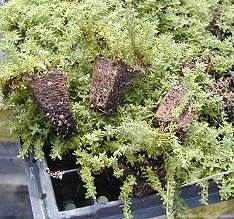
Most of our Thymes come in two sizes, a 3 inch pot and the 128 plug tray (which is 128 tiny plants in separate cells in a tray). These containers should be thoroughly watered on the day of planting. The ground should also be wet, but not soggy. Remove the plant carefully from its container. Avoid pulling on the top part of the plant and instead coax the plant from the bottom of the container so the roots are not damaged.
The hole in the ground should be just deep enough to bury the plant at the same level it was buried in in its original container. Firm the plants into their hole by gently tapping down the ground around the plant. Making good root contact with the soil around it will help the Thyme to take off faster.
Keeping plants moist, especially their root zone, after planting is extremely important. If the soil around the root ball is too dry it will wick water away from the plant causing dehydration of the root zone. It is necessary to keep the root balls moist until the roots start to grow into the soil around them.
Mulching the bare ground when the Thyme is first planted helps to retain moisture and get the plants off to a successful start. Mulching also helps to keep weeds at bay. A small particle mulch requires about a three-inch depth covering the bare soil around the new plants. The larger the mulch particles, the deeper the mulch should be. Avoid mulching right around the thyme plant. An airspace of about three-inches around the plant will keep it from being composted by the mulch. In six months or so, mulches may need to reapplied as they decompose and start to show bare dirt. The idea is to keep weed seeds from getting the light they need to sprout.
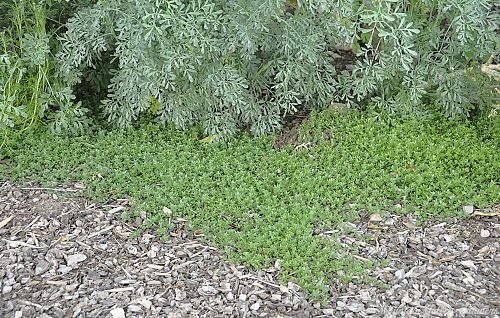
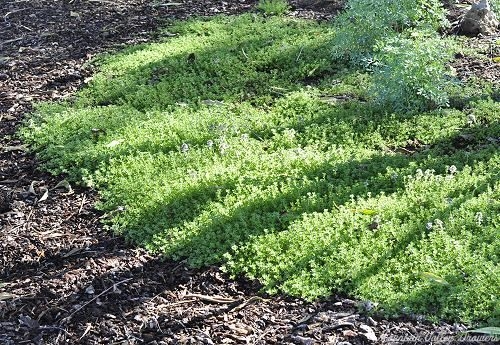
Normally, Thymes don’t require fertilizer or pruning. They may be pruned away from other plants once or twice a year. Pruning too often causes plants to produce few leaves and exposes woody stems. Low mowing is not recommended but spent flower stems could be removed by a mower set at two or there inches high or a high pass with a weed eater.
Check here to see which Ground Cover Thyme Plug Trays are available.